
Introduction
Space science has become an important part of modern technology, communication, weather forecasting, navigation, scientific research, and national development. India has developed a strong space program over several decades, supported by an organization that has played a central role in designing satellites, launching spacecraft, conducting scientific missions, and developing space technologies. For students and general readers, understanding the full form of ISRO is a useful starting point for learning about India’s achievements in space research.
ISRO is widely recognized as India’s primary space research organization. Its activities extend across satellite communication, Earth observation, navigation, meteorology, scientific exploration, launch vehicles, and planetary missions. The organization has also contributed to applications that affect everyday life, including television broadcasting, telecommunications, disaster management, agriculture, mapping, weather monitoring, and resource planning. Its development reflects India’s gradual progress from early experimental space activities to sophisticated missions involving the Moon, Mars, and other advanced areas of space science.
What Is the Full Form of ISRO?
The full form of ISRO is Indian Space Research Organisation. It is the national space agency of India and operates under the Department of Space, Government of India. The organization is responsible for a broad range of activities related to space science, satellite technology, launch systems, and space-based applications.
The name itself describes the organization’s purpose. “Indian” represents its national role, “Space Research” reflects its scientific and technological focus, and “Organisation” identifies it as an institutional body responsible for coordinating and carrying out space-related activities. ISRO has developed capabilities across multiple areas, including spacecraft design, launch vehicle development, satellite applications, remote sensing, navigation, and planetary exploration.
History of ISRO
The history of India’s organized space program began before ISRO itself was established. Indian scientists recognized the potential of space technology for communication, scientific research, weather observation, and national development. The Indian National Committee for Space Research, known as INCOSPAR, was established in 1962 under the leadership of scientists including Dr. Vikram Sarabhai.
ISRO was established in 1969, building on the earlier institutional efforts in Indian space research. The organization subsequently became part of the Department of Space, which was established in 1972. Over time, India’s space program expanded from experimental satellite projects into a comprehensive system covering launch vehicles, communication satellites, Earth observation, navigation, scientific exploration, and human-spaceflight capabilities.
Who Founded ISRO?
Dr. Vikram Sarabhai is widely regarded as the father of the Indian space program and played a foundational role in the development of India’s space research activities. He strongly supported the use of advanced technology for national development and scientific progress.
Sarabhai’s vision emphasized practical applications of space technology rather than treating space exploration only as an academic pursuit. This approach influenced India’s early satellite and communication programs. His contributions established an important foundation for the organization that eventually developed into ISRO and helped shape India’s long-term space strategy.
Main Functions of ISRO
ISRO performs many functions connected with space science and technology. One major responsibility is the development and operation of satellites used for communication, Earth observation, navigation, meteorology, and scientific research. These satellites provide information and services that support numerous activities on Earth.
Another important function is launch vehicle development. ISRO has developed several launch systems capable of placing satellites and spacecraft into different orbits. The organization also conducts scientific missions to study the Moon, Mars, the Sun, and other areas of space. These activities require expertise in engineering, physics, electronics, computing, materials science, communications, and many other technical disciplines.
ISRO and Satellite Technology
Satellites are one of the most important areas of India’s space program. Different satellite systems serve different purposes. Communication satellites can support telecommunications and broadcasting, while Earth-observation satellites collect information about land, oceans, agriculture, forests, water resources, and environmental conditions.
Satellite data can also support disaster management. Images and other information collected from space can help authorities monitor floods, cyclones, landslides, drought conditions, and other events. These applications demonstrate how space technology can provide practical benefits beyond scientific exploration.
ISRO Launch Vehicles
Developing reliable launch vehicles has been a major part of India’s space program. Launch vehicles carry satellites and spacecraft from Earth into designated orbits. India has developed multiple launch vehicle families for different mission requirements.
The Polar Satellite Launch Vehicle, commonly known as PSLV, became one of India’s important launch systems and has been used for numerous Earth-observation, scientific, navigation, and commercial missions. The Geosynchronous Satellite Launch Vehicle, or GSLV, was developed for heavier payloads and missions requiring geostationary orbits. More advanced launch systems have also been developed as India’s space ambitions have expanded.
Major Space Missions
India’s space program includes a range of notable scientific missions. The Chandrayaan missions have focused on lunar exploration and have contributed to scientific knowledge about the Moon. Chandrayaan-1 was India’s first lunar mission and played an important role in lunar research.
The Mars Orbiter Mission, also known as Mangalyaan, demonstrated India’s ability to conduct an interplanetary mission. The mission successfully entered Mars orbit in 2014 and operated for several years. ISRO has also developed missions focused on solar observation and astronomy, demonstrating the increasing scientific scope of India’s space program.
Chandrayaan and Lunar Exploration
Lunar exploration has become an important part of India’s scientific activities. Chandrayaan-1, launched in 2008, carried out observations of the Moon and helped advance understanding of lunar surface characteristics. Later missions continued India’s lunar exploration efforts.
Chandrayaan-3 achieved a significant milestone when its lander successfully soft-landed on the Moon in August 2023. The mission included a lander and rover designed to conduct scientific experiments on the lunar surface. Its success demonstrated India’s growing capabilities in precision landing and lunar surface operations.
ISRO and Solar Research
Space missions are also used to study the Sun. India’s Aditya-L1 mission was designed to observe the Sun from a special location called the first Sun-Earth Lagrange point, or L1. Positioning a spacecraft there provides an advantageous location for continuous observation of the Sun.
Solar research is important because activity on the Sun can influence the space environment around Earth. Solar storms and related phenomena can affect satellites, communications, navigation systems, and other technologies. Scientific observations therefore contribute to a better understanding of solar activity and space weather.
ISRO’s Role in Everyday Life
The impact of India’s space program is not limited to astronauts and scientists. Satellite technology supports many practical activities used by people and institutions. Communication satellites have contributed to broadcasting and telecommunications, while navigation systems support location-based services and transportation.
Earth-observation data can help governments and organizations monitor agriculture, water resources, forests, urban development, and natural disasters. Weather-related satellite information can also contribute to forecasting and emergency preparedness. These applications demonstrate why space research can have a direct connection with development on Earth.
ISRO and Navigation Technology
India has also developed its own regional satellite navigation system, known as NavIC, or Navigation with Indian Constellation. The system is designed to provide positioning, navigation, and timing services over India and surrounding regions.
Navigation technology has applications in transportation, surveying, disaster management, agriculture, mapping, and other fields. Developing an indigenous navigation capability can also strengthen technological independence and provide specialized services for national requirements.
ISRO and Human Spaceflight
Human spaceflight represents another major area of India’s space ambitions. The Gaganyaan program is designed to demonstrate India’s capability to conduct human spaceflight missions. It involves developing spacecraft systems, launch capabilities, crew-support technologies, safety systems, and other infrastructure required for human missions.
Human spaceflight is considerably more complex than launching an unmanned satellite because astronauts require life-support systems, reliable environmental controls, emergency procedures, and extensive safety measures. The development of these technologies represents an important stage in India’s broader space program.
Why ISRO Is Important for Students
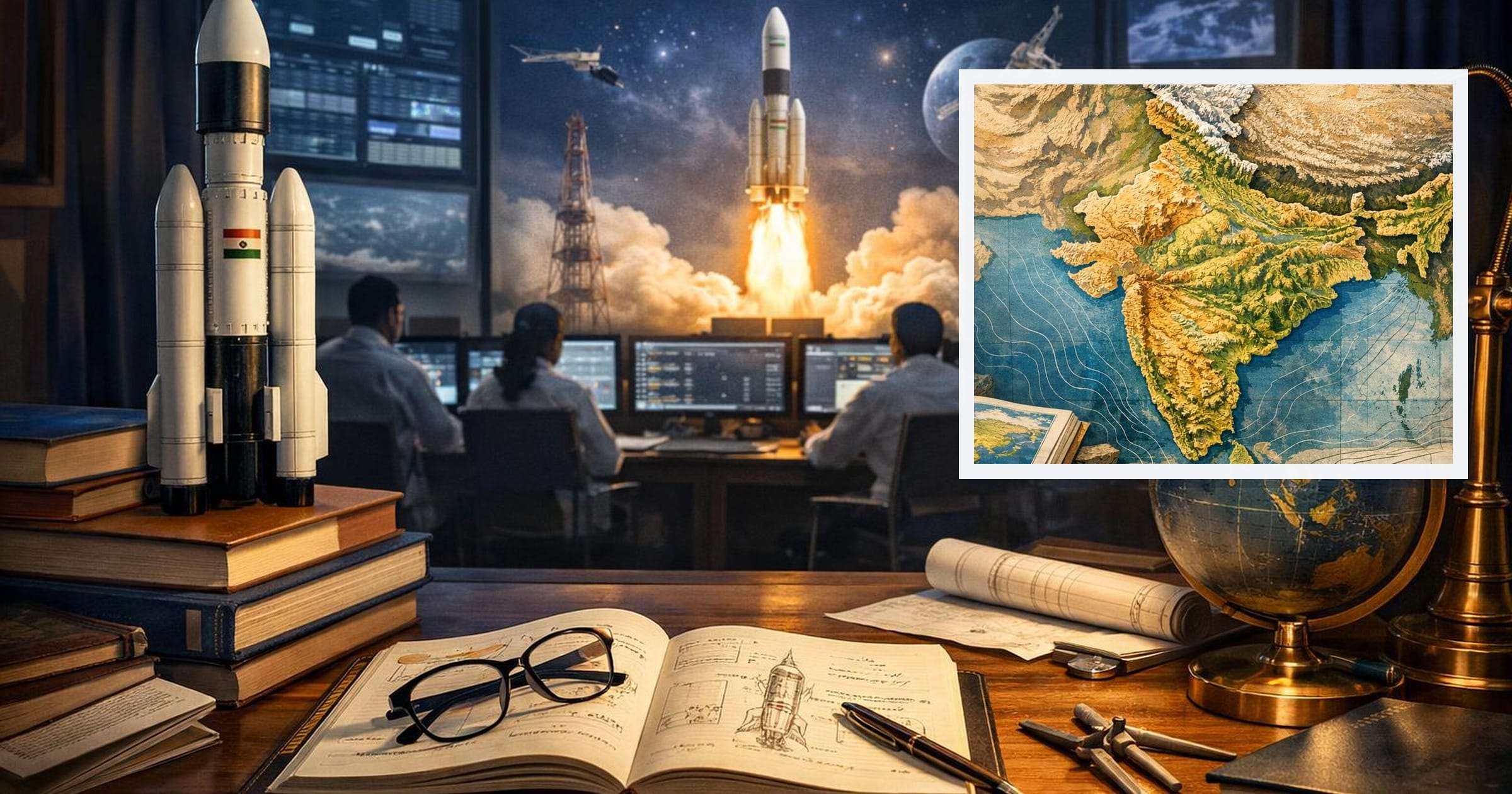
Understanding the full form of ISRO can help students explore subjects such as physics, mathematics, engineering, astronomy, computer science, and environmental studies. India’s space program demonstrates how scientific knowledge can be transformed into practical technologies and large-scale missions.
Students interested in space careers can explore many different fields. Space organizations require scientists, engineers, software developers, electronics specialists, mechanical engineers, communication experts, researchers, technicians, and project managers. Learning about ISRO can therefore encourage interest in STEM education and scientific research.
ISRO and India’s Future in Space
India’s space program continues to expand into areas such as advanced launch systems, human spaceflight, planetary science, solar research, satellite technology, and commercial space activities. The organization is also working within a broader national space ecosystem that includes private companies and research institutions.
The future of India’s space activities is likely to involve increasingly complex missions and technologies. Reusable launch concepts, advanced spacecraft, deeper scientific exploration, and stronger commercial participation could all contribute to the evolution of India’s space sector. Continued investment in research, education, infrastructure, and skilled professionals will remain important.
Interesting Facts About ISRO
The full form of ISRO is Indian Space Research Organisation, but its history represents much more than the expansion of four letters. The organization grew from India’s early experimental space activities into a major national institution involved in satellites, launch vehicles, planetary missions, navigation, and scientific research.
ISRO has conducted missions involving the Earth, Moon, Mars, and the Sun. Its launch vehicles have placed Indian and international satellites into orbit, while its satellite systems have supported applications ranging from communication to environmental monitoring. These achievements demonstrate the breadth of India’s space capabilities.
Conclusion
The full form of ISRO is Indian Space Research Organisation, India’s national space agency responsible for a wide range of space science and technology activities. Established in 1969, ISRO has developed from India’s early space research efforts into an organization involved in satellites, launch vehicles, Earth observation, navigation, planetary exploration, solar research, and human-spaceflight development.
From the pioneering vision of Vikram Sarabhai to missions such as Chandrayaan, Mangalyaan, and Aditya-L1, India’s space journey demonstrates the importance of long-term scientific development. ISRO’s work has also created practical benefits in communication, agriculture, disaster management, navigation, weather observation, and resource planning. For students and general readers, learning the full form of ISRO is an introduction to a much broader story of science, engineering, innovation, and India’s continuing exploration of space.