
Introduction
Technology has become an important part of modern life, changing how people communicate, work, study, shop, and solve everyday problems. One of the most significant technological developments is Artificial Intelligence, commonly known as AI. It helps computers and machines perform tasks that traditionally require human intelligence, such as understanding language, recognizing images, identifying patterns, and making predictions. From smartphone assistants to online recommendations, AI is becoming increasingly common in homes, schools, offices, hospitals, and industries.
The full form of AI is Artificial Intelligence. It refers to the ability of computer systems and machines to perform specific tasks that usually involve human thinking, learning, reasoning, and decision-making. AI technologies use data, algorithms, and computational methods to generate results and improve performance on particular tasks. Although AI can perform many impressive activities, it does not necessarily think, understand, or experience the world in the same way humans do.
Understanding AI is useful for students, professionals, business owners, and anyone interested in modern technology. Learning about its meaning, applications, advantages, and limitations can help people make informed decisions about using intelligent digital tools. As AI continues to develop, its influence on education, healthcare, transportation, communication, and business is expected to grow further.
What Is the Full Form of AI?
The full form of AI is Artificial Intelligence. The term combines two words: artificial, which means something created by humans, and intelligence, which refers to the ability to learn, understand, reason, and solve problems. Together, these words describe computer systems designed to perform tasks associated with human intelligence.
Artificial intelligence is a broad field of computer science that focuses on developing systems capable of processing information and producing useful outputs. These systems can analyze large amounts of data, recognize patterns, understand spoken or written language, and make predictions based on available information. Different AI applications are developed for different purposes, so their capabilities vary considerably.
For example, an email service may use AI to identify spam messages, while a navigation application can analyze traffic conditions to recommend a suitable route. A learning platform may suggest educational material based on a student’s progress. These examples show how artificial intelligence can support everyday activities by processing information quickly and helping users complete tasks more efficiently.
How Does Artificial Intelligence Work?
Artificial intelligence works through a combination of algorithms, data, computing power, and mathematical techniques. Developers design AI systems to process information and identify patterns that help them produce an answer, prediction, recommendation, or other output. The precise process depends on the type of AI technology and the problem it is designed to solve.
One important approach is machine learning, in which computer systems learn patterns from examples rather than relying entirely on individually written rules. For instance, a machine-learning model trained on many labeled images may learn to distinguish between cats and dogs. Once trained, it can analyze a new image and estimate which category it belongs to. The accuracy of the result depends on the quality of the training data, the model design, and the conditions in which it is used.
Another important approach is deep learning, which uses artificial neural networks containing multiple processing layers. These networks are particularly useful for complex tasks involving images, audio, language, and large datasets. Generative AI can also create new content, including text, images, music, and computer code. However, AI outputs can contain mistakes, so important information should be checked before it is used.
Main Types of Artificial Intelligence
Artificial intelligence can be classified in different ways, including by its capabilities and the techniques it uses. Understanding these categories helps explain why some systems perform narrow, specialized tasks while others can generate content or assist with more complex activities.
1. Narrow AI
Narrow AI, also called weak AI, is designed to perform a particular task or a limited range of tasks. Most AI applications currently used in everyday life fall into this category. Examples include voice assistants, facial recognition systems, recommendation engines, translation tools, and email spam filters. These systems can perform specific functions effectively but do not possess general human intelligence.
2. Generative AI
Generative AI creates new content based on patterns learned from training data. It can generate written answers, summarize documents, create illustrations, produce music, and assist with programming. Chatbots and AI writing tools are familiar examples. Their results can be useful starting points, but users should review generated material for factual errors, originality, suitability, and possible bias.
3. General AI
Artificial general intelligence refers to a hypothetical form of AI that could learn and perform a broad range of intellectual tasks at a level comparable to human capabilities. It remains an important research concept rather than an established, universally recognized technological achievement. Current AI systems can be powerful without possessing this kind of general intelligence.
Common Uses of AI in Everyday Life
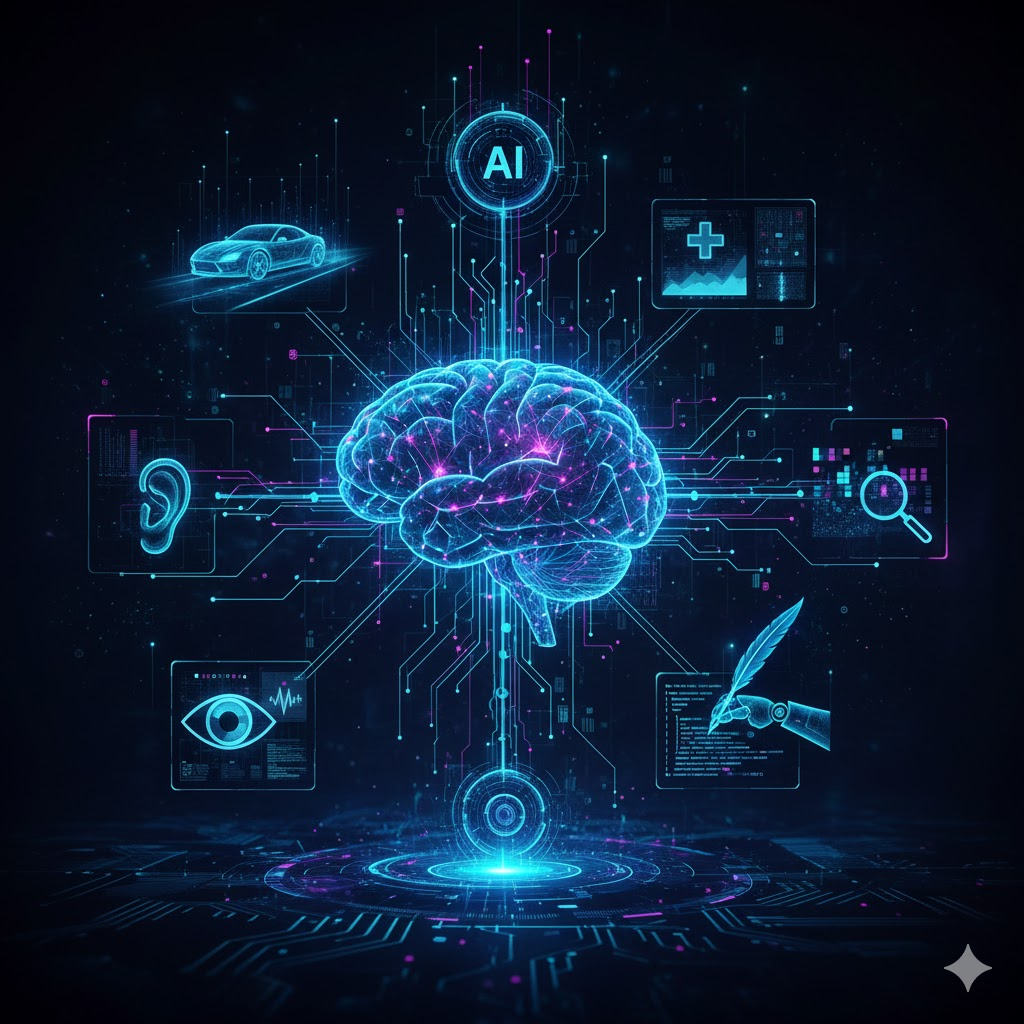
Artificial intelligence is already integrated into many digital services people use regularly. It often operates behind the scenes, making applications more responsive, personalized, or efficient without requiring users to understand the underlying technology.
Smartphones use AI-related technologies for features such as speech recognition, photo enhancement, predictive text, and voice commands. Streaming services and online shopping platforms may analyze viewing or purchasing behavior to recommend relevant content and products. Email applications use automated systems to filter unwanted messages, while maps can estimate journey times using information about traffic and road conditions.
AI also supports customer service through chatbots that answer common questions and direct users toward appropriate resources. In homes, intelligent devices can respond to voice commands, adjust certain settings, or automate routine tasks. Although these applications can save time, they may also rely on personal information, making privacy settings and responsible data practices important considerations.
Importance of AI in Education
Artificial intelligence is changing how students learn and how teachers prepare educational materials. AI-powered educational tools can explain difficult concepts, generate practice questions, summarize lessons, and help learners review topics at their own pace. These features can be especially useful when students need additional explanations or want to practice a subject outside regular classroom hours.
Teachers can also use AI to develop lesson plans, organize learning resources, create examples, and assist with certain administrative tasks. Some educational platforms analyze student performance to identify areas where additional practice may be helpful. However, these tools should support rather than replace the professional judgment of teachers.
Students should use AI responsibly by checking information against reliable learning materials and following their institution’s academic integrity policies. Submitting generated answers without understanding them can weaken learning and critical-thinking skills. The greatest educational value comes when AI helps students ask better questions, explore ideas, and develop their own understanding.
Role of AI in Healthcare
Healthcare is another field where artificial intelligence has significant potential. AI systems can assist qualified professionals in analyzing medical images, organizing patient information, identifying patterns in research data, and supporting certain clinical decisions. These technologies may help medical teams manage information and identify findings that deserve further investigation.
For example, specialized systems can assist with reviewing radiology images or detecting patterns in large collections of medical records. Researchers can also use AI tools to analyze biological information and investigate potential treatments. In hospital administration, automation may help with appointment scheduling, documentation, and other routine processes.
However, AI should not be treated as a replacement for qualified healthcare professionals. Medical decisions require clinical expertise, patient context, and careful consideration of risks. AI systems may produce inaccurate results or perform differently across patient groups. Appropriate testing, privacy protection, regulatory oversight, and professional supervision are therefore essential.
Benefits of Artificial Intelligence
Artificial intelligence offers several potential benefits when it is developed and applied responsibly. Its ability to process large datasets and automate repetitive activities can improve productivity in many settings. By handling routine work, AI may allow people to spend more time on tasks requiring creativity, communication, and complex judgment.
The main benefits include:
-
Automation: AI can help perform repetitive tasks with less manual effort.
-
Speed: It can process large amounts of information quickly.
-
Data analysis: AI can identify patterns that may be difficult to detect manually.
-
Personalization: It can support customized recommendations and learning experiences.
-
Accessibility: Speech recognition, transcription, and translation tools can help people access information in different ways.
-
Decision support: AI can provide predictions and insights that help professionals evaluate options.
These advantages do not guarantee that every AI application will be accurate, fair, or cost-effective. Organizations need to evaluate results, monitor performance, protect sensitive information, and maintain human oversight. When these conditions are met, AI can become a valuable tool for improving services and supporting informed decisions.
Challenges and Limitations of AI
Despite its benefits, artificial intelligence presents important challenges. One major concern is accuracy. AI systems may generate incorrect information, misunderstand a request, or produce convincing answers that are not supported by evidence. Users should therefore verify important claims, particularly in healthcare, finance, law, education, and other high-impact areas.
Privacy is another concern because some AI applications process personal, professional, or confidential information. Organizations must handle such data carefully and follow relevant privacy requirements. Bias can also affect AI outcomes when training data or system design reflects unfair assumptions. This may lead to unequal results for different groups of people.
Employment is another area of discussion. Automation can change the responsibilities associated with certain jobs, reduce demand for some repetitive tasks, and create demand for new technical and analytical skills. The effects vary across industries and occupations. Learning new skills, adapting to changing workflows, and developing strong human abilities can help workers prepare for these changes.
Finally, developing and operating advanced AI systems may require substantial computing resources, electricity, and financial investment. Responsible implementation involves balancing potential benefits against environmental, economic, social, and security considerations.
Difference Between AI, Machine Learning, and Deep Learning
AI, machine learning, and deep learning are related terms, but they do not mean exactly the same thing. Artificial intelligence is the broad field concerned with developing machines that can perform tasks associated with intelligence. Machine learning is a subset of AI that enables systems to learn patterns from data. Deep learning is a subset of machine learning that uses multilayer neural networks to model complex patterns.
| Technology | Meaning | Example |
|---|---|---|
| Artificial Intelligence | The broader field of intelligent computer systems | A virtual assistant |
| Machine Learning | Learning patterns from data | A spam detection model |
| Deep Learning | Using multilayer neural networks | Image recognition |
| Generative AI | Producing new content | A text-generating chatbot |
These categories can overlap. A generative AI application may use deep learning models trained through machine-learning techniques. Understanding this relationship makes it easier to follow discussions about modern technologies and their practical applications.
Future of Artificial Intelligence
The future of artificial intelligence will likely involve deeper integration into workplaces, educational systems, scientific research, and consumer applications. AI tools may become more useful for analyzing complex information, assisting with creative projects, automating administrative tasks, and supporting communication across languages. Advances in robotics may also allow intelligent systems to perform a wider range of physical tasks in controlled environments.
At the same time, future progress will depend on how effectively developers and institutions address accuracy, security, transparency, and accountability. Governments, businesses, educators, and technology researchers will need to consider appropriate safeguards as AI becomes more capable and widely adopted.
People can prepare by learning basic digital skills, improving their ability to evaluate information, and understanding how automated systems influence their work. Skills such as critical thinking, creativity, collaboration, and ethical reasoning will remain important. Rather than assuming AI will solve every problem, individuals and organizations should focus on using it where it provides clear value and can be monitored effectively.
Why Is It Important to Learn About AI?
Learning about artificial intelligence helps people understand the technology behind many modern services. Students can explore future career opportunities, professionals can identify useful workplace applications, and business owners can evaluate whether automation may improve their operations. Basic AI knowledge also helps people recognize limitations and avoid relying blindly on automated recommendations.
A practical starting point is to experiment with simple tools, compare their outputs with reliable sources, and learn how to write clear instructions. Users should also understand the importance of data privacy, intellectual property, and responsible use. These habits can make AI more useful while reducing the risks associated with inaccurate or inappropriate outputs.
As intelligent technologies continue to develop, AI literacy will become increasingly valuable. People do not necessarily need to become programmers to benefit from AI, but understanding its basic principles can help them use digital tools more thoughtfully and make better decisions.
Conclusion
Artificial intelligence is one of the most influential areas of modern technology, with applications across education, healthcare, business, communication, and everyday life. It helps computer systems analyze information, recognize patterns, automate tasks, and generate useful content. Its growing adoption creates opportunities to improve productivity, accessibility, and decision-making while also introducing concerns involving privacy, accuracy, fairness, and employment.
The full form of AI is Artificial Intelligence, a term that describes computer systems designed to perform tasks commonly associated with human intelligence. Understanding this concept provides a foundation for learning about machine learning, deep learning, and generative AI. Although AI offers valuable capabilities, it works best when combined with human judgment, appropriate safeguards, and careful evaluation. By developing AI literacy and using intelligent tools responsibly, people can better understand technological change and prepare for the opportunities and challenges ahead.