
Introduction
Medical education is one of the most popular career choices among students who dream of becoming doctors and working in the healthcare sector. Every year, lakhs of students across India prepare for medical entrance examinations to secure admission into undergraduate medical courses. Among these examinations, NEET is considered one of the most important because it provides a common entrance pathway for students seeking admission to several medical programmes. Understanding the full form of NEET is the first step for students who want to explore medical education and learn about the admission process.
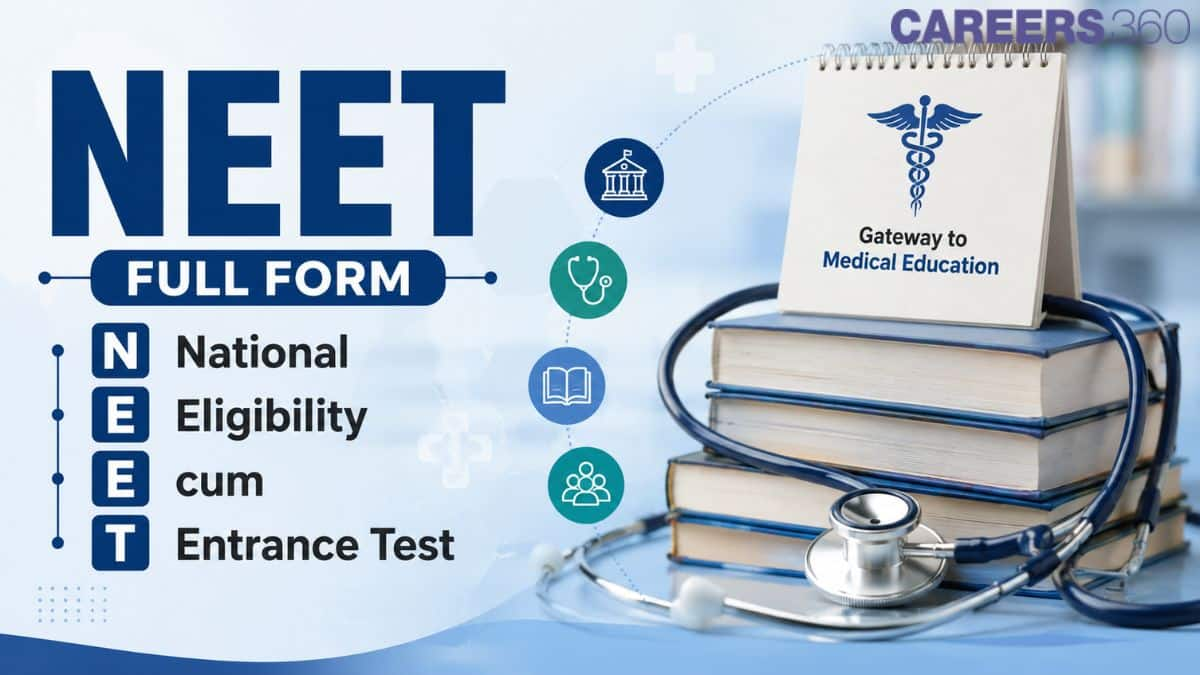
The full form of NEET is National Eligibility cum Entrance Test. It is a national-level entrance examination conducted for students seeking admission to undergraduate medical courses, including MBBS and other eligible programmes. The examination evaluates students’ knowledge of Physics, Chemistry, and Biology, which are essential subjects for medical studies. NEET provides a standardised examination system through which students from different educational boards and states can compete for medical seats based on their performance, eligibility, and applicable admission rules.
1. What Is NEET?
NEET is a national-level medical entrance examination designed for students who want to pursue undergraduate medical education in India. It is used as the entrance examination for admission to various medical programmes offered by government, private, and other participating institutions. The examination helps assess whether students have the academic knowledge and understanding required to begin professional medical studies. Since medical courses involve a strong foundation in scientific concepts, NEET focuses primarily on subjects studied during Classes 11 and 12.
The examination is an important part of the medical admission system because it provides a common platform for candidates from different schools, educational boards, and regions. Students must prepare according to the prescribed syllabus and meet the eligibility conditions to participate. Qualifying the examination does not automatically guarantee admission to a particular college. Candidates must also participate in counselling, meet the required cutoff criteria, and secure a seat according to their rank, category, preferences, and seat availability.
2. History and Purpose of NEET
The medical admission system in India has evolved over the years to make the selection process more organised and consistent. Previously, students often had to appear in multiple entrance examinations conducted by different states, institutions, and medical colleges. This created additional pressure because candidates needed to prepare for different examination patterns, application procedures, dates, and eligibility requirements. A common medical entrance examination was introduced to simplify the admission process and reduce the need for students to take several separate tests.
The purpose of NEET is to create a unified entrance examination system for eligible undergraduate medical admissions. It evaluates candidates through a common question paper and provides a standardised assessment of their understanding of science subjects. The system also aims to make the admission process more transparent by using examination scores and ranks as important factors during counselling. Students can apply for participating institutions through the relevant admission procedures instead of relying entirely on individual college entrance tests.
3. Why NEET Is Important for Medical Students
NEET is important because it serves as a major entrance requirement for students who want to study medicine in India. A student interested in becoming a doctor must understand the examination structure, eligibility requirements, syllabus, and admission process before beginning preparation. Without proper knowledge of these factors, candidates may find it difficult to organise their studies or make informed decisions about their educational plans. The exam also encourages students to develop a strong understanding of fundamental science concepts rather than depending only on memorisation.
Another important aspect is that the examination allows candidates from different backgrounds to compete through a common assessment system. Students studying in government schools, private schools, state boards, and central educational boards can participate if they fulfil the eligibility requirements. The importance of NEET extends beyond the examination itself because the score and rank can influence the colleges and courses available during counselling. For this reason, students often begin preparing well before their final school examinations.
4. Courses Available Through NEET
Medical and related undergraduate courses
NEET is primarily associated with MBBS admission, but its score is also used for several other undergraduate medical and related programmes, subject to current regulations and participating institutions. Students should understand the differences between these courses before choosing their preferred career path. Every programme has a different curriculum, duration, professional scope, and type of work. Choosing a course based on personal interests, abilities, and long-term career goals is more useful than selecting it only because it is popular.
Some courses and programmes associated with NEET-based admissions include:
-
MBBS: Bachelor of Medicine and Bachelor of Surgery, a professional degree for students pursuing a career as a medical doctor.
-
BDS: Bachelor of Dental Surgery, a programme focused on dental health, oral care, and dental treatment.
-
BAMS: Bachelor of Ayurvedic Medicine and Surgery, related to Ayurvedic medical education.
-
BHMS: Bachelor of Homeopathic Medicine and Surgery, focused on homeopathic medical studies.
-
BUMS: Bachelor of Unani Medicine and Surgery, associated with Unani medical education.
-
BSMS: Bachelor of Siddha Medicine and Surgery, focused on Siddha medicine.
-
BVSc and AH: Veterinary programmes, where applicable admission rules and requirements may use NEET scores.
-
Other eligible programmes: Certain nursing or related courses may have separate or institution-specific admission requirements, so students should verify the applicable rules.
The availability of these courses through NEET depends on the relevant regulatory framework, participating institutions, and counselling authorities.
5. NEET Eligibility Criteria

Eligibility criteria are important for every student who wants to appear in the medical entrance examination. Candidates must check their educational qualifications, age-related requirements, subjects, and other conditions before applying. These rules are established under the applicable examination and medical education regulations. Students should not rely on assumptions or outdated information because eligibility requirements may be revised or clarified from time to time.
Generally, candidates must have completed or be appearing in Class 12 or an equivalent qualifying examination with the required science subjects. Physics, Chemistry, Biology or Biotechnology, and English are important subjects for undergraduate medical eligibility. Students must also satisfy the minimum qualifying marks requirements applicable to their category and follow the conditions specified in the official information bulletin. Candidates who are studying in Class 12 can also apply if they meet the relevant conditions at the required stage.
Age criteria are another factor students should review carefully. Candidates need to meet the minimum age requirement specified for the examination and admission process. The rules concerning eligibility, qualifying examinations, category requirements, and documentation should always be checked using the official notification for the particular examination year.
6. Subjects Included in NEET
The examination is based mainly on three subjects: Physics, Chemistry, and Biology. These subjects are important because they provide the scientific foundation required for medical education. Candidates need to study concepts from both Class 11 and Class 12 rather than concentrating only on their final-year syllabus. Understanding how the subjects connect with medical science can also make learning more meaningful.
Physics
Physics examines natural phenomena, matter, energy, motion, forces, and the principles that explain how the physical world operates. Students preparing for the examination study concepts such as mechanics, thermodynamics, waves, electricity, magnetism, optics, and modern physics. Physics often requires a combination of conceptual understanding, mathematical skills, and regular numerical practice.
Chemistry
Chemistry focuses on the properties, composition, structure, and reactions of substances. Its syllabus generally includes Physical Chemistry, Organic Chemistry, and Inorganic Chemistry. Students need to understand chemical equations, reaction mechanisms, periodic properties, bonding, calculations, and important theoretical concepts. Regular revision is helpful because Chemistry contains both conceptual and memory-based areas.
Biology
Biology is especially important for aspiring medical students because it covers living organisms, biological systems, and the processes that support life. Topics include cell biology, genetics, evolution, plant physiology, human physiology, ecology, reproduction, and biotechnology. Students should carefully study definitions, diagrams, processes, examples, and textbook explanations. A clear understanding of Biology can help candidates build the knowledge required for later medical studies.
7. NEET Exam Pattern
Understanding the examination pattern is an important part of preparation. Students should know the number of questions, marking scheme, duration, subject-wise structure, and examination instructions. These details help candidates prepare a realistic strategy for attempting the paper. The examination pattern can be revised by the conducting authority, so students should confirm the latest structure before their examination year.
The examination generally assesses students through objective-type multiple-choice questions. Candidates are required to select the correct answer from the options provided for each question. The paper covers Physics, Chemistry, and Biology, with Biology commonly divided into Botany and Zoology sections. The marking scheme usually includes marks for correct answers and a penalty for incorrect answers, making accuracy an important part of preparation.
Students should practise under timed conditions to become familiar with the examination environment. Solving practice papers helps candidates understand how much time they need for different subjects and which questions they should attempt first. Rather than spending too much time on one difficult question, candidates can learn to manage their time effectively and return to challenging questions when possible.
8. How to Apply for NEET
The application process usually takes place online through the official examination portal. Students should carefully read the information bulletin before completing the application form because it contains important instructions about registration, eligibility, fees, documents, examination centres, and submission deadlines. Applying correctly is essential because errors in personal information or academic details may create problems during later stages of admission.
The general application process includes the following steps:
-
Visit the official examination application portal.
-
Complete the registration process using the required personal details.
-
Create the login credentials according to the instructions.
-
Fill in the application form with educational and other information.
-
Upload the required photograph, signature, and supporting documents in the prescribed format.
-
Pay the applicable examination fee through the available payment methods.
-
Review the form carefully before final submission.
-
Download or save the confirmation page for future reference.
Candidates should keep their registration details, application number, confirmation page, and relevant documents safely stored. They should also regularly check official announcements for updates regarding correction windows, admit cards, examination dates, and other important information.
9. NEET Preparation Tips for Students
Preparation for a national-level medical entrance examination requires consistency, discipline, and a clear understanding of the syllabus. Students should avoid depending entirely on last-minute study because Physics, Chemistry, and Biology contain many concepts that need repeated practice. A well-organised preparation strategy can help candidates manage their school studies alongside entrance examination preparation.
The first step is to understand the syllabus and divide it into manageable sections. Students can create a timetable that gives adequate time to all three subjects while focusing more on their weaker areas. Biology requires regular reading and revision, Chemistry needs a combination of conceptual learning and practice, and Physics requires problem-solving skills. Candidates should set realistic daily targets instead of creating schedules that are difficult to follow.
Another useful preparation method is to practise questions regularly. Previous-year questions, mock tests, topic-wise exercises, and sample papers can help students understand the types of questions asked and identify areas that need improvement. After completing a test, candidates should review incorrect answers and understand why they made mistakes. This process can improve accuracy, confidence, and time management over the course of preparation.
10. Importance of NCERT Books
NCERT textbooks play a major role in medical entrance preparation because they provide a structured explanation of important scientific concepts at the school level. Students should carefully read the relevant Class 11 and Class 12 textbooks for Physics, Chemistry, and Biology. Biology students should pay special attention to definitions, diagrams, examples, tables, and explanatory details. Chemistry students can use the textbooks to build a strong foundation in basic principles and important reactions.
Reading textbooks once is usually not enough for effective preparation. Students should revise important chapters several times and make short notes that help them remember difficult concepts. These notes can include formulas, reaction summaries, diagrams, definitions, and frequently confused topics. However, notes should support textbook learning rather than replace it entirely.
For Physics, students should focus on understanding formulas and their applications instead of memorising equations without knowing how they work. Chemistry requires careful study of theoretical concepts and reaction patterns, while Biology benefits from detailed textbook reading and repeated revision. A balanced approach to textbook study and question practice can help students develop a stronger foundation.
11. Role of Mock Tests and Previous-Year Questions
Mock tests are an important preparation tool because they allow students to practise answering questions within a limited time. They help candidates become familiar with the examination format, develop a question-attempting strategy, and evaluate their preparation level. Regular mock tests can also reduce nervousness by making students more comfortable with timed examinations.
Previous-year questions provide useful insight into the kinds of concepts that have been tested in earlier examinations. They can help students identify recurring themes, understand the level of difficulty, and practise applying their knowledge. However, candidates should not assume that the same questions will be repeated. The main purpose of previous-year questions is to develop familiarity with the subject and improve problem-solving ability.
After every mock test, students should analyse their performance. They can divide mistakes into categories such as conceptual errors, calculation mistakes, misreading questions, poor time management, and unnecessary guessing. Reviewing these mistakes can be more valuable than simply taking another test without understanding the previous results. A consistent cycle of practice, evaluation, and revision helps students gradually improve.
12. NEET Counselling and Admission Process
After the examination results are announced, eligible candidates may participate in counselling according to the applicable admission rules. Counselling is the process through which candidates select their preferred colleges and courses, and seats are allocated based on merit, eligibility, reservation rules, preferences, and seat availability. The counselling process may involve different authorities for national-level and state-level admissions.
Candidates should understand that qualifying the examination and securing admission are two different stages. A student may qualify but still need a sufficiently competitive rank to obtain a seat in a preferred college or programme. Admission opportunities depend on several factors, including the number of available seats, candidate performance, category, college preferences, and the counselling round.
During counselling, students should carefully research colleges and compare their academic facilities, hospital exposure, location, infrastructure, fees, hostel availability, and other relevant factors. They should also read the counselling instructions and complete registration, choice filling, document verification, and seat acceptance within the prescribed deadlines. Missing an important deadline may affect a candidate’s admission opportunity.
13. Career Opportunities After NEET
Students who enter medical education through NEET can pursue several career paths depending on their selected course, interests, and professional qualifications. An MBBS graduate may work in hospitals, clinics, healthcare organisations, community health programmes, or pursue postgraduate medical education. Medical professionals can specialise in different areas, including general medicine, surgery, paediatrics, dermatology, radiology, cardiology, and many other branches after meeting the required postgraduate eligibility and training conditions.
Dental graduates may pursue careers in dental clinics, hospitals, academic institutions, or specialised dental practice. Students pursuing Ayurveda, Homeopathy, Unani, or Siddha courses may develop careers within their respective systems of medicine, subject to professional regulations. Veterinary graduates can work with animal healthcare, veterinary hospitals, livestock services, research, and related sectors.
Healthcare careers also extend beyond direct patient treatment. Medical graduates may explore research, public health, teaching, healthcare administration, medical writing, clinical research, and other fields after gaining suitable education, experience, and qualifications. The choice of career depends on a student’s interests, abilities, commitment, and long-term professional goals.
14. Common Challenges Faced by NEET Aspirants
Preparing for a competitive examination can be demanding, especially when students are balancing school examinations, coaching classes, revision, and personal responsibilities. One of the common challenges is managing a large syllabus within a limited period. Students may feel overwhelmed when they see the number of chapters across Physics, Chemistry, and Biology. Breaking the syllabus into smaller targets can make the preparation process more manageable.
Another challenge is maintaining consistency. Some candidates study intensively for a few days but struggle to follow their timetable over a longer period. Developing a realistic routine with sufficient sleep, breaks, revision, and practice can help students avoid burnout. Studying for excessive hours without proper rest may reduce concentration and productivity.
Competition and examination pressure can also affect confidence. Students may compare their scores with those of friends or other candidates and become discouraged. It is more productive to track personal improvement, identify weaknesses, and focus on achievable goals. A steady preparation routine, positive learning habits, and regular assessment can help students deal with academic pressure more effectively.
15. How Students Can Manage Time During Preparation
Time management is an essential skill for medical entrance preparation. Students should divide their available time between learning new chapters, revising completed topics, practising questions, and evaluating performance. A timetable should be flexible enough to accommodate school examinations, difficult chapters, and unexpected changes. The objective is not to study every minute of the day but to use study time efficiently.
Candidates can begin their day with a subject that requires greater concentration and then move to another subject after a reasonable study session. Short breaks can help maintain attention. Students should also reserve time for reviewing previous topics because learning new chapters without revision can lead to forgetting important concepts. Weekly assessments can provide a clear picture of progress and help students adjust their schedules.
A practical preparation routine may include textbook reading, concept learning, numerical practice, question solving, and a short revision session. Students should also keep track of chapters they have completed and topics they need to revisit. By following a consistent routine, candidates can gradually improve their preparation without unnecessary stress.
16. Mistakes to Avoid While Preparing
Many students make avoidable mistakes during medical entrance preparation. One common mistake is relying only on memorisation without understanding the concepts. Although memory is important, students must also learn how to apply their knowledge to different questions. Another mistake is ignoring one subject because it appears difficult. A balanced approach is necessary because performance across all subjects can influence the final score and rank.
Students should also avoid collecting too many books and study materials. Using multiple resources for the same chapter can create confusion and consume valuable time. It is often more beneficial to study the syllabus systematically, understand the recommended textbooks, and use a limited number of supplementary resources for practice.
Other mistakes include skipping revision, taking mock tests without analysing them, following unrealistic timetables, and neglecting sleep. Candidates should remember that preparation is a long-term process. Building consistent study habits, practising regularly, and correcting mistakes are more useful than depending on shortcuts or unverified advice.
Frequently Asked Questions (FAQs)
1. What is the full form of NEET?
The full form of NEET is National Eligibility cum Entrance Test. It is a national-level entrance examination for eligible students seeking admission to undergraduate medical courses in India. The examination evaluates candidates in Physics, Chemistry, and Biology and is an important part of the medical admission process.
2. Who conducts NEET?
The National Testing Agency (NTA) conducts NEET-UG as the national entrance examination for undergraduate medical admissions. The conducting authority publishes official notifications containing details about registration, eligibility, examination dates, syllabus, and other instructions. Students should check the latest notification for accurate information.
3. Which subjects are required for NEET?
The main subjects required for preparation are Physics, Chemistry, and Biology. Candidates generally need the relevant subjects in their qualifying school examination, along with English and other applicable eligibility requirements. Students should verify the current official criteria before applying.
4. Can Class 12 students appear for NEET?
Yes, eligible students appearing in Class 12 or an equivalent qualifying examination may apply, provided they satisfy the relevant eligibility conditions. They must fulfil the required academic qualifications at the appropriate stage of admission. Candidates should carefully check the current information bulletin for complete details.
5. Is NEET compulsory for MBBS admission in India?
NEET-UG is the common entrance examination used for MBBS admission in India under the applicable medical admission regulations. Students seeking MBBS admission generally need to qualify the examination and participate in the appropriate counselling process. Admission also depends on rank, eligibility, seat availability, and other applicable rules.
6. Can students get admission after qualifying NEET?
Qualifying NEET makes candidates eligible to participate in the relevant admission process, but it does not guarantee a medical seat. Candidates must meet the admission cutoff requirements and participate in counselling. The final seat allocation depends on merit, preferences, category rules, available seats, and the admission authority’s procedures.
Conclusion
Understanding the full form of NEET, which stands for National Eligibility cum Entrance Test, is an important starting point for students who aspire to enter the medical profession. The examination provides a common platform for candidates seeking undergraduate medical education and evaluates their knowledge of Physics, Chemistry, and Biology. It also plays an important role in the admission process for various medical programmes across participating institutions in India.
Students who want to succeed should focus on understanding the syllabus, studying NCERT textbooks, practising previous-year questions, taking mock tests, and revising regularly. Good time management, consistency, and a positive approach can make preparation more organised and effective. NEET is a challenging examination, but a clear strategy and dedicated effort can help students work towards their medical career goals. With proper preparation and informed decisions about courses and counselling, aspiring students can take meaningful steps towards building a future in healthcare.